 Prospects Pulse
RESEARCH / OUTBOUND
Outbound lead generation for IT services companies
Your delivery team can solve a hard problem. Your first message needs to show which problem, for which company, and why it matters now. We build outbound around that connection.
For founders and sales heads at IT services, data and AI, and software services firms, we build researched account lists around a clear buying reason, write role-based email and LinkedIn messages, handle replies, and book first meetings your team then qualifies.
A broad capability pitch is hard to answer
IT services buyers hear from firms offering digital transformation, cloud, software engineering and AI every day. Those capabilities may all be real. But a prospect still needs a reason to stop and respond. A catalogue of services leaves them to work out the relevance themselves.
Referrals can bring strong opportunities, but they do not provide a steady view of the market. When referrals slow, sending the same company introduction to a larger list rarely fixes the underlying issue. You need a specific account group with a recognisable problem and an offer your delivery team can explain.
We work with IT services firms selling to business buyers in the US, UK, UAE, India and Europe. The market changes the research and message. It does not change the need for a clear account rule, a useful reason to write and someone ready to handle the conversation.
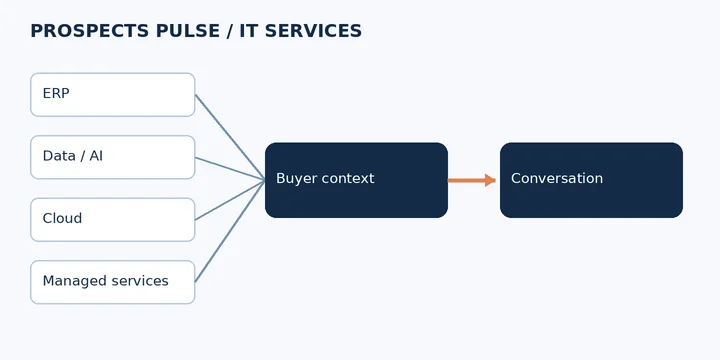
Select accounts using evidence of a need
We look for signals that connect your service to an account. The same research powers our database building and account research. A legacy platform mentioned in a job ad may support an ERP research brief. Hiring for a data function may suggest a team with an active remit. A tender may set out a requirement directly. Cloud or technology mentions can give context for further checking.
A signal is not a purchase order. We check its date, the company it refers to and whether it actually supports your offer. A subsidiary using one system does not establish the stack of the whole group. A recruitment agency posting a vacancy is not necessarily the end customer.
You help define what makes an account useful. Existing customer examples, unsuitable projects and delivery constraints are all part of that brief. We would rather narrow a campaign around work you can win and deliver than fill a sheet with companies that share a broad industry label.
More ways we spot a reason to write
Two further clues often help. News of funding, a new site or entry into a new market can point to a team under fresh pressure to build or support systems. A partner listing, marketplace presence or joint offer with a platform you work alongside can also mark a natural fit. We treat both as starting points for checking, never as proof of a live project.
Build a distinct offer for each service line
For ERP, Dynamics or SAP migrations, start with the platform and the business consequence of staying on it. A useful first conversation might explore a migration question or a relevant assessment. Avoid implying you know a system is failing simply because a public document mentions an older product.
For data and AI services, identify a workflow before discussing a model. A prospect needs to understand the operational question you can help answer. If you offer a prototype or demonstration, agree what your presales team can produce. We only describe something as built when it exists; proposed work stays an offer.
For cloud services, connect the message to a specific operating change, workload or hiring signal. For managed services, explain the support problem and which team would own it. A broad promise to reduce costs is weak without context. Different service lines can share a company list, but should not automatically share the same message.
Offers by service line
Every service you lead with needs its own reason to write. These are the angles we use for each line.
Managed services: write to the support load the in-house team feels each week. Name the cover gap, the response problem or the system that needs steady care, and be clear about which part your team would own.
Cloud and migration: point to one workload, one platform move or one change the account is already weighing up. Talk about order, readiness and continuity, not cloud in general terms.
Data and AI: begin with the decision or task the work should improve. Ask about the data behind it and who uses the result. Offer to explore a small example only where your presales team can build it after a reply.
ERP, SAP and Dynamics: lead with the platform in place and what staying on it means for planning. Our page on SAP, Dynamics and ERP partners sets out that route in full, including how we check platform evidence before writing.
Staff augmentation: name the skill gap and the piece of work it is holding up. Set out the skills you can supply and the shape of engagement you offer, and let the reader judge fit for a defined need rather than a general bench.
Software development: point to the product, portal or internal system the account needs built or joined up. Keep the first message on the problem and your relevant build experience, and invite a technical talk when there is a real project to discuss.
Match the message to the decision
A CFO needs to see the commercial reason for a conversation: exposure, spending priorities or the consequence of delaying a change. Keep the language grounded in what your service can actually address. Avoid invented savings calculations or assumptions about a company’s budget.
We usually begin with the CEO or CFO where they own the business decision. A CIO or CTO may still be relevant when the brief needs technical ownership. Their questions are different: migration dependencies, security review, integration and continuity. Technical detail belongs where it helps that role assess relevance, rather than being pasted into every first message.
Agree the route into the account before launch. Contacting every senior title with a different story can create confusion. The opening message should make the same honest offer, with the emphasis adjusted for the person reading it. Your technical team then owns the deeper discovery and demonstration.
Who each message is for
Two more roles deserve their own words. A Head of IT tends to judge a message on service continuity, support load and how a change lands on the team, so keep the operational detail close to the offer. A Head of Data looks at data quality, access and ownership of the result, so name the workflow and the data it relies on. The finance lead still needs the commercial reason, in plain terms and without invented savings.
Email and LinkedIn with a reason to follow up
We run cold email and LinkedIn outreach. The cadence is agreed around the market, the available account evidence and your ability to respond. A follow-up should make the relevance easier to see, address an obvious question or offer a useful next step. Repeating a vague introduction adds little.
We review what attracted replies and which conversations became meetings before changing the next campaign. Low activity is not automatically a copy problem, and an interested reply is not automatically a qualified opportunity. Keep account relevance, delivery and the offer separate enough to see where the work is needed.
Suppression and opt-out handling apply across the campaign. Public account signals do not remove the need to review the intended use of personal data and the rules in each market. We discuss that scope before outreach, including any source or audience that should be excluded. We also talk plainly about personal data before launch, covering sources, exclusions and how opt-outs are held across the campaign. Prospects Pulse Ltd is registered with the Information Commissioner's Office (ICO), registration number ZC285130.
What the first month looks like
We start by agreeing the buyer profile, the lead offer and the accounts to leave out. You share the customer examples that show your best work, the jobs your team cannot take, and the person who will attend meetings. We then test the account sources on a small set, so a weak rule shows up before wider research begins.
Next we carry out the research and contact checks, and you review the draft messages before anything is sent. We agree the send approach, the follow-up rhythm and the route a good reply takes to your team. Treat this as a planning frame rather than a set order for every brief, because readiness differs. We promise no meeting counts and no launch dates here.
A person owns the response
AI helps sort incoming replies into positive, neutral and brush-off groups. Positive replies reach the team’s chat promptly so a person can pick them up while the context is fresh. The reply-sorting Insight below explains the process in the original company post. Automation supports attention; the team still answers.
You agree what makes a first meeting worth taking, supply the offer detail and make the right person available. We handle the outreach, replies and scheduling within the agreed scope. You own qualification, the demo, proposal and close. Booking a meeting does not mean we have established budget or a purchase commitment.
Our existing client-results page includes work for Aivantor, Benchmark IT Solutions and Skylark. Read the individual examples and original client words there. They are evidence of specific work, with their own context. We do not turn those accounts into a promise of the same outcome for a different service line or market.
Bring a delivery-ready brief
Tell us what your best project looks like, which countries you sell into and which services you want to lead with. Include the account conditions that matter and the jobs your team cannot take on. An honest boundary improves both targeting and the first conversation.
If the offer involves a built artifact, confirm what presales can deliver before we write the campaign. If there is no artifact yet, we can offer to explore one without implying it exists. The first discussion should make the next step concrete for both teams, from the account research through to who attends the meeting.
When this is not a fit
If no one in the account owns the budget or the decision, outbound rarely repays the effort. The same is true when your own team has no capacity to deliver the work a campaign could create, or no one available to take the meetings. Fix those points first and the outreach has something solid behind it.
A missing proof story matters too. If you have not yet delivered in the niche you want to target, say so early. We can talk about honest angles from work nearby, but we will not dress up experience you do not have. A clear no at the start saves both sides time.
A few useful answers
Is this a fit for our IT services firm?
It fits where a named person owns the budget decision, your team can deliver the work, and you can point to a proof story you stand behind. If any of those is missing, we will say so early rather than start outreach on weak ground.
What happens in the first month?
We agree the buyer profile, the lead offer and the accounts to leave out, then test account sources on a small set. Research and contact checks follow, you review the messages, and we agree the reply route before launch. It is a planning frame, not a promised schedule or result.
Which buyers do you contact?
We agree the route per account. The finance lead gets the commercial reason in plain terms. Technical chiefs and Heads of IT get the migration, security and continuity points. A Head of Data gets the workflow, data quality and ownership points. One honest offer runs through each version.
Can you promote more than one service line?
Yes, where each line has its own account reason and message angle. Managed services, cloud, data and AI, ERP, staff augmentation and software development should not share one broad message. We keep the lines separate so the reader can judge relevance fast.
How do you handle personal data?
We agree sources, exclusions and opt-out handling before launch, and opt-outs are held across the campaign. Prospects Pulse Ltd is registered with the Information Commissioner's Office (ICO), registration number ZC285130.
Can we see a sample before we commit?
Yes. Use the sample offer on this page to request the sample of checked contacts in your niche. Share your service line, target market and buyer roles, and the sample shows how we research and check accounts before any wider work.
Start with your buyer profile.
Free sample: 25 checked contacts in your niche. No card, no contract.
Send us a quick enquiry.
A person will reply. No call needed.